

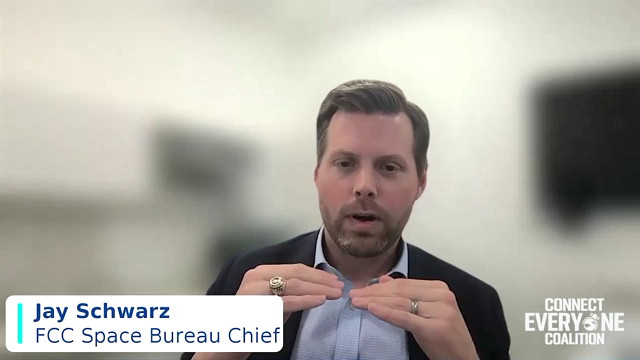
ASK JAY! FCC SPACE BUREAU CHIEF JAY SCHWARZ ON THE FUTURE OF CONNECTIVITY AND THE “SPACE INDUSTRIAL REVOLUTION”
May 28, 2026
In CEC Fireside Chat, Jay Schwarz Shares Perspective on How Space Policy Modernization and Next-Generation LEO Broadband Technologies Can Expand High-Speed Internet Access
In case you missed it, Federal Communications Commission (FCC) Space Bureau Chief Jay Schwarz joined the Connect Everyone Coalition (CEC) this month for a fireside chat. Schwarz discussed the importance of modernizing U.S. space policy and the role of emerging technologies such as low Earth orbit (LEO) satellite broadband in finally and fully closing the digital divide.
Chief Schwarz discussed the growing and multifaceted ways that space-based innovations are impacting life on Earth, from expanded broadband access to economic growth and development:
“I fairly regularly now call it the Space Industrial Revolution… I’ve had the chance in this role to visit factories from space companies and see … assembly lines where people are building satellites in America… I can assure you, in the space industry, there is a lot of manufacturing going on.”
Chief Schwarz emphasized the need for pro-innovation advocates to translate complex and technical policy debates into plain language, spelling out the tangible benefits for people and communities. He noted that the future of connectivity depends on securing a smarter, forward-looking set of rules that keeps pace with innovation and unlocks meaningful outcomes for consumers, communities and the broader economy.
“Often, the rulemakings that we’re doing and the issues we’re dealing with are just very technical… And I think one of the things that can be helpful is making it clear – translating this technical thing actually leads to these real-world benefits that matter for folks. And the nature of the telecom world is everybody in the industry is going to fight for their position. You have incumbents who don’t want to lose out, and you have the new folks who are maybe innovating and trying to break in and butting up against old rules. And so, innovation is really good. It brings a lot of benefits to communities. Helping translate these technical rules, if they’re fixed, is going to lead to beneficial things that we want.”
Jay emphasized that space continues to play a larger role in the global conversation, with most of the agenda for the 2027 World Radiocommunication Conference (WRC-27) now focusing on space issues. He said the U.S. should lead by example, especially on spectrum policy and Equivalent Power Flux Density (EPFD) limits, and show that modernized rules can improve broadband performance:
“So, for those who may not be familiar, WRC-27 is every four years through the International Telecommunication Union, where we go and talk about global harmonization of spectrum… [T]his year, 80 percent of the items relate to space issues. That’s a much higher percentage than has mattered in the past, and it demonstrates the importance of space and the prominence that it’s gained. It’s also very important for the U.S. to succeed at WRC-27 so that we can maintain our position…
“There are many important items on the agenda, but one which relates to something I just talked about is there are ongoing discussions about these power limits … to allow American operators in the U.S. to operate at higher power limits and ultimately deliver better broadband. We only made that change for the U.S. There is an ongoing international discussion about those power limits globally, and so that’ll be a discussion. We view what we did also as an opportunity to show American leadership … and we’re going to demonstrate that it works in the United States. And then we want to encourage other countries to be able to pick up that model and reconsider these power limits for their own country, because ultimately, it’s going to benefit the people that live there as well.
“We’re trying to be leaders in that respect, showing this new, modernized path can actually work for your country, and build a coalition of countries that are willing to embrace innovation in this area.”
Jay also shared insight into how in-flight connectivity is reshaping expectations and likely to become a major competitive advantage for airlines. In his view, the experience of fast, reliable, in-air internet shows just how quickly connectivity standards are changing – and how compelling LEO service can be as a consumer-facing innovation.
“I was just at lunch today talking with some friends about the experience of using the [LEO] service on an airplane. It blows your mind, if you think about it. I, for one, can remember the pre-internet era, and then you’re sitting there at 35,000 feet, getting 300 megabits per second – for free, on United, by the way. And so, that’s quite the experience. I don’t know the answer for all of the major carriers, but I have to think that this will be a competitive differentiator for these airlines going forward, because it’s such a great experience.”
As the “Space Industrial Revolution” accelerates, the next era of connectivity is rapidly taking shape. By adopting policies that promote space innovation, modernizing outdated regulations and accelerating access to LEO satellite broadband, the FCC will play a key role bolstering economic prosperity and bridging the digital divide for individuals, families and communities across the nation.
Watch the full webinar HERE.
Read more about Chief Schwarz’s remarks HERE.
Learn more about the CEC’s mission to connect everyone, everywhere, HERE.